Subsidy Programme for Cinematographic and Television Filming in Macao
-
2026 Subsidy Programme for Cinematographic and Television Filming in Macao (1)
-
2026 Subsidy Programme for Cinematographic and Television Filming in Macao (2)
-
2026 Subsidy Programme for Cinematographic and Television Filming in Macao (3)
-
-
2026 Subsidy Programme for Cinematographic and Television Filming in Macao (5)
-
2026 Subsidy Programme for Cinematographic and Television Filming in Macao (6)
-
Funding Purpose
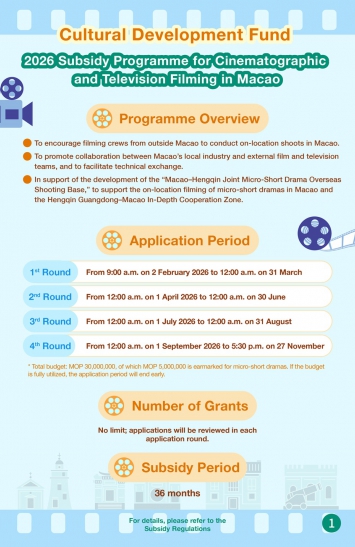
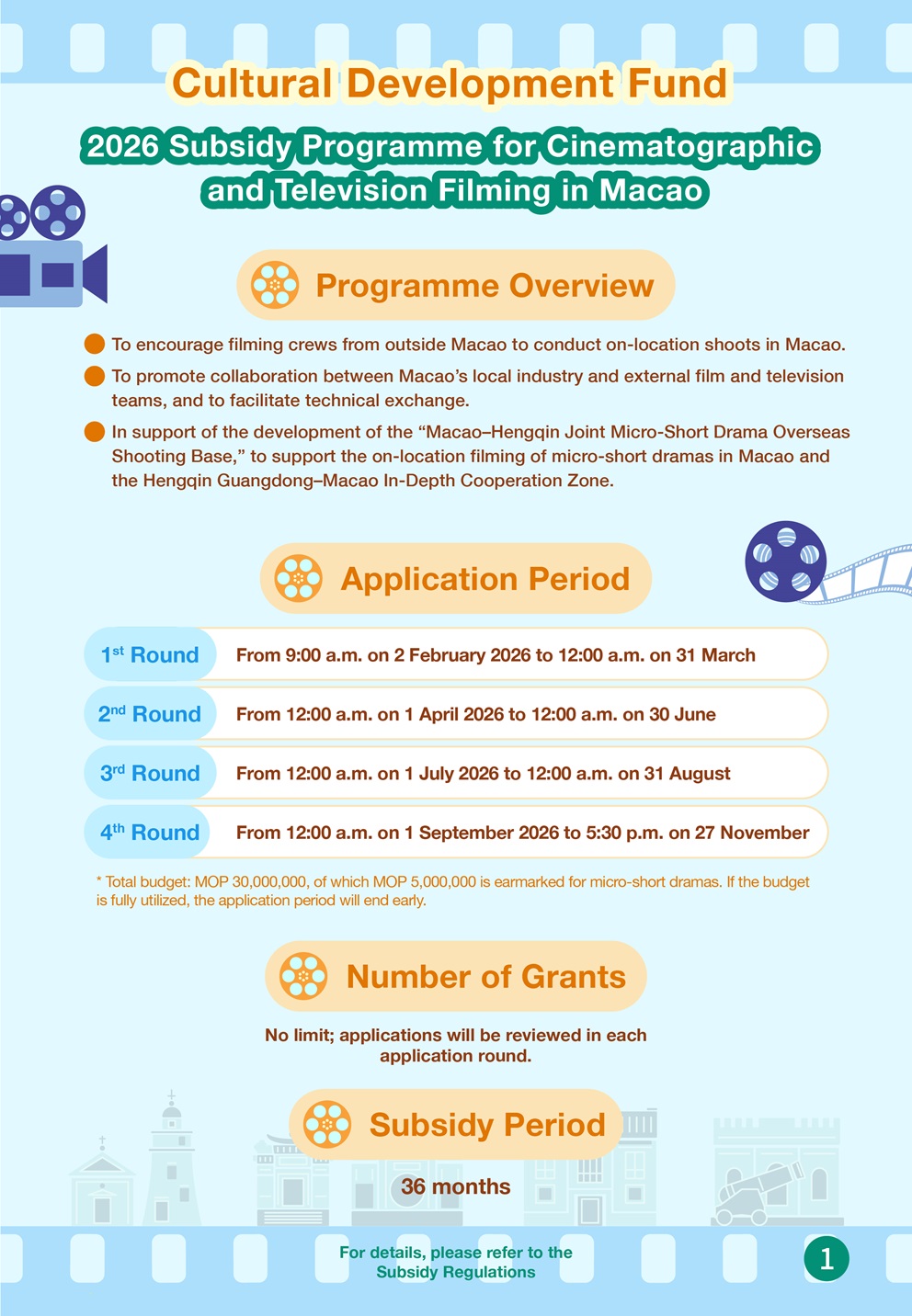
1.1The Cultural Development Fund has established this Subsidy Programme to encourage or attract filming crews from outside Macao to conduct on-location shoots in Macao, thereby strengthening the promotion of Macao’s positive image, driving the synergistic development of cultural and creative industries and tourism, and creating job opportunities for local film and television professionals. It aims to facilitate technical exchange and cooperation with external teams and help enhance the professional standards of local film and television production. The scope of funding covers projects involving on-location shooting of micro-short dramas in Macao and the Hengqin Guangdong–Macao In-Depth Cooperation Zone, in support of the construction of the “Macao–Hengqin Joint Micro-Short Drama Overseas Shooting Base.”
-
Application Period
2.1The application period is divided into four rounds. After each round closes, the Fund will arrange a unified evaluation for all project applications submitted during that period. There is no quota limit per round. If the budget for this Subsidy Programme is fully utilized, the application period will end early, and an announcement will be made on the Fund’s website. The application periods are as follows: First Round From 9:00 a.m. on February 2, 2026 to 12:00 a.m. on March 31, 2026 Second Round From 12:00 a.m. on April 1, 2026 to 12:00 a.m. on June 30, 2026 Third Round From 0:00 a.m. on July 1, 2026 to 12:00 a.m. on August 31, 2026 Fourth Round From 0:00 a.m. on September 1, 2026 to 5:30 p.m. on November 27, 2026
-
Scope of Funding
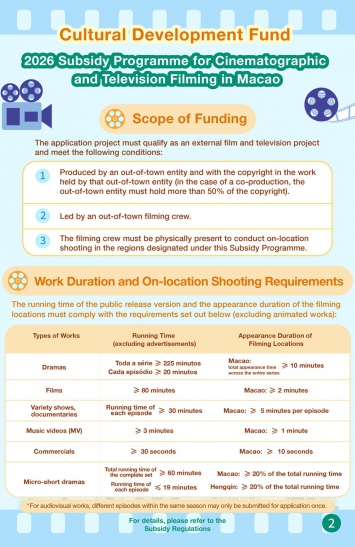
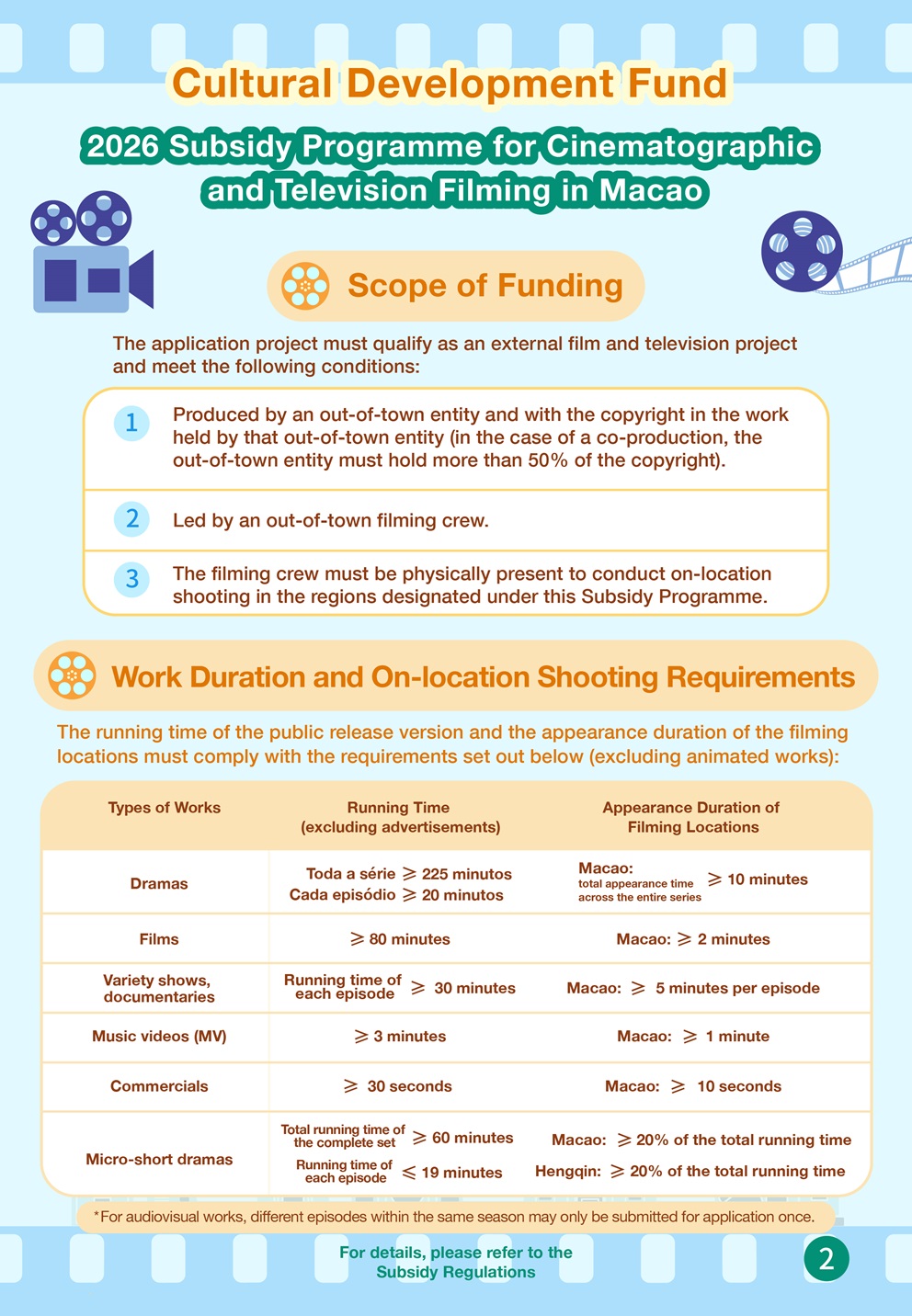
3.1Television dramas, films, variety shows, documentaries, music videos (MV), and commercial video works that meet the following durations and conduct filming/scene shooting in Macau, excluding animated works. Moreover, different episodes within the same season can only apply once: 3.1.1Television dramas with a total duration of no less than 225 minutes excluding advertisements, and individual episode duration of 20 minutes or more, with Macau locations appearing for no less than 10 minutes across the entire series; 3.1.2Films with a duration of no less than 80 minutes, with Macau locations appearing for no less than 2 minutes; 3.1.3Variety shows or documentaries with an individual episode duration of no less than 30 minutes excluding advertisements, with Macau locations appearing for no less than 5 minutes. If the project consists of more than one episode, each episode applying must meet the requirements of an ad-free duration of no less than 30 minutes and Macau locations appearing for no less than 5 minutes; 3.1.4Music videos (MV) with a duration of no less than 3 minutes, with Macau locations appearing for no less than 1 minute; 3.1.5Commercials with a duration of no less than 30 seconds, with Macau locations appearing for no less than 10 seconds. 3.2Micro-short drama film and television works that meet the following durations and conduct filming and location shooting in Macao and the Hengqin Guangdong–Macao In-Depth Cooperation Zone (hereinafter referred to as “Macao–Hengqin”), excluding animated works, and for which only one application may be submitted per season across different episodes: 3.2.1For a complete set of micro-short dramas with no advertisements, the total runtime must be no less than 60 minutes, and the runtime of each episode must not exceed 19 minutes; moreover, locations in Macao and Hengqin must each appear for no less than 20% of the total runtime. 3.3Belongs to an out-of-town film and television project, meaning the film and television work is produced by an out-of-town entity and the copyright in the work is held by that out-of-town entity (in the case of a co-production, the out-of-town entity must hold more than 50% of the copyright), is led by an out-of-town filming crew, and is shot on location in the regions referred to in point 3.1 or point 3.2 (the out-of-town team must be physically present locally to participate in the filming work).
-
Funding requirements
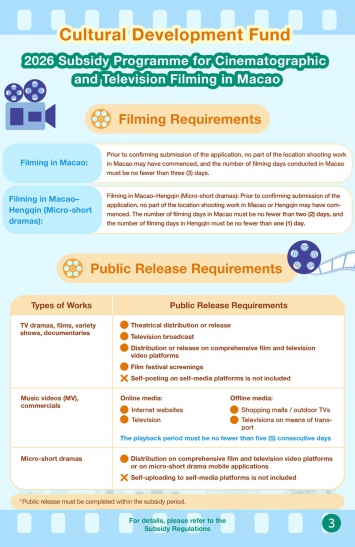
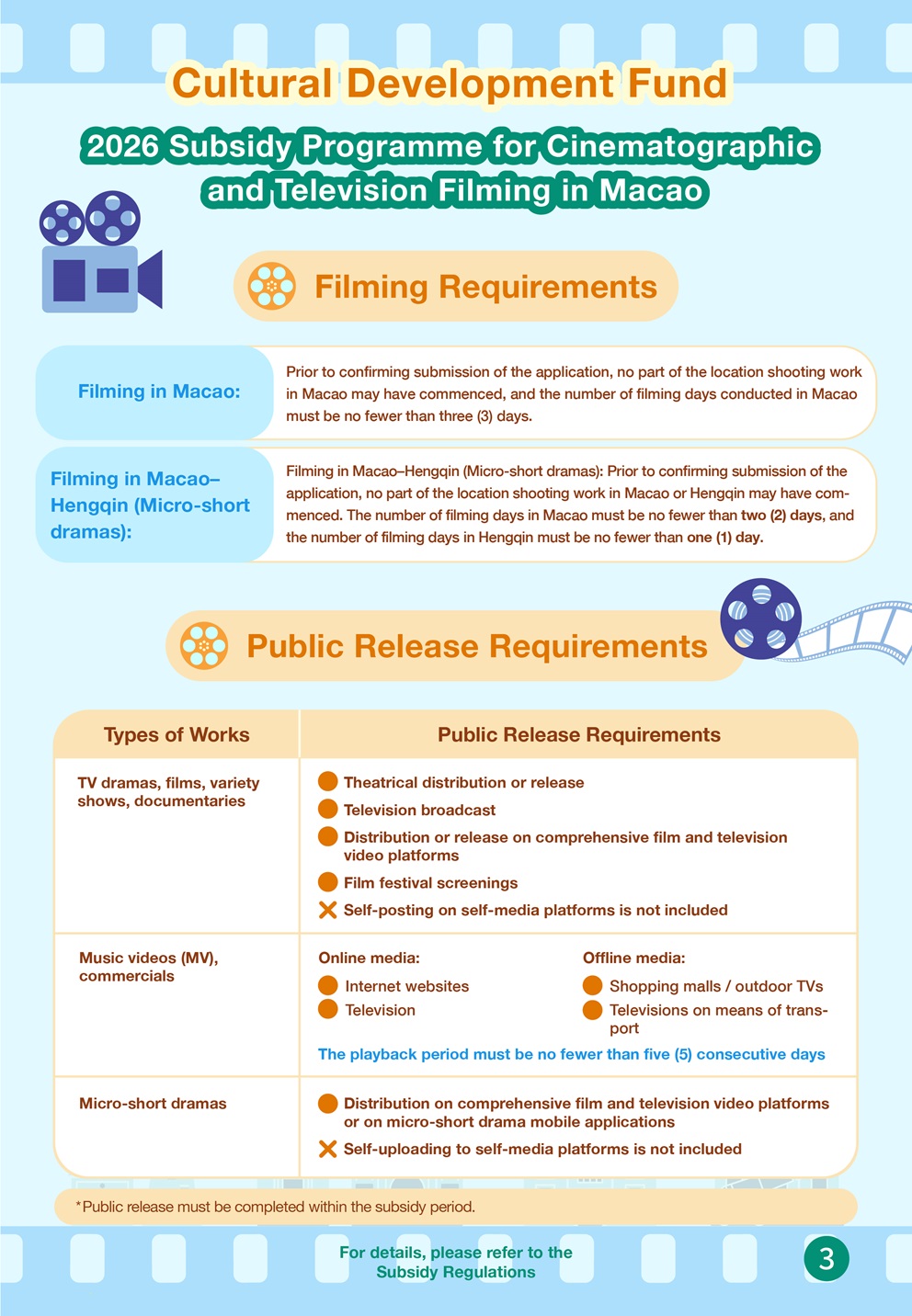
4.1Regarding filming: 4.1.1For applications involving TV dramas, films, variety shows, documentaries, music videos (MV), and commercials, prior to confirming submission of the application, no part of the location shooting work in Macao may have commenced, and the number of days of filming conducted in Macao must be no fewer than 3 days. 4.1.2For applications involving micro-short dramas, prior to confirming submission of the application, no part of the location shooting work in Macao or Hengqin may have commenced, and the number of days of filming in Macao must be no fewer than 2 days, while the number of days of filming in Hengqin must be no fewer than 1 day. 4.2Regarding public release: 4.2.1For applications involving TV dramas, films, variety shows, documentaries, music videos (MV), and commercials, public release must be completed within the funding period, and the running time of the release version and the appearance of Macao locations must be no less than the time limits stipulated in point 3.1. 4.2.1.1For TV dramas, films, variety shows, and documentaries, public release refers to public screenings, namely theatrical distribution or release, television broadcast, distribution or release on comprehensive film and television video platforms (including websites or mobile applications), and film festival screenings; it does not include self-posting on self-media platforms. 4.2.1.2For music videos (MV) and commercials, public release refers to playback on online media such as internet websites, television broadcast, and playback on offline media such as shopping malls or outdoor TVs and televisions on means of transport, with a playback period of no fewer than 5 consecutive days. 4.2.2For applications involving micro short dramas, public release must be completed within the funding period, and the length of the theatrical release version as well as the appearance of filming locations in Macao and Hengqin must not be less than the time limits specified in point 3.2. Public release of micro short dramas refers to distribution on comprehensive film and video platforms (including websites or mobile applications) or on micro short drama mobile applications, but does not include self-uploading to self-media platforms. 4.3The content of projects funded by the Fund must not simultaneously receive financial support from other public departments or public entities in Macao, nor may they receive grants from other programmes of the Fund at the same time.
-
Eligibility and Target Beneficiaries
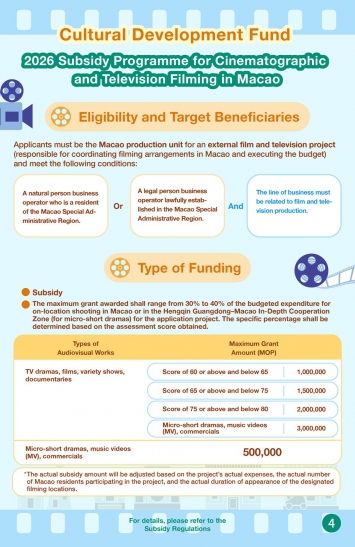
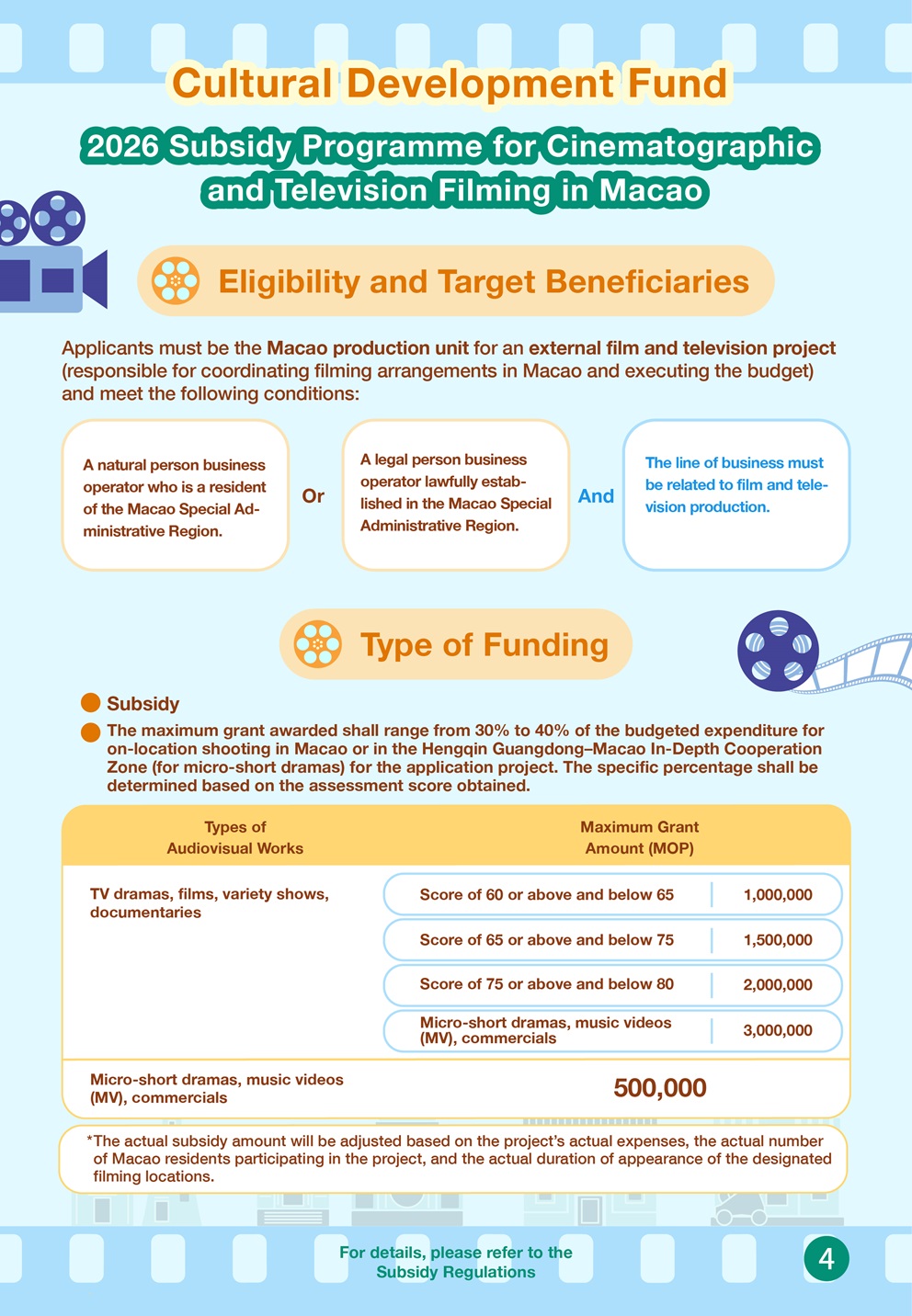
5.1Applicants must be natural person business operators or legal person business operators lawfully established and operating in the Macao Special Administrative Region, and must be the Macao production unit for “External Film and Television Projects” (responsible for coordinating filming arrangements in Macao and executing the budget), and meet the following conditions: 5.1.1If the applicant is a natural person business operator, they must be a resident of the Macao Special Administrative Region, and their enterprise must be registered with the Financial Services Bureau for tax purposes. 5.1.2If the applicant is a legal person business operator, it must be lawfully established in the Macao Special Administrative Region, and the enterprise must be registered with the Financial Services Bureau for tax purposes. 5.1.3The line of business must be related to film and television production (as evidenced by the business registration information in point 12.1.1, the business tax declaration in point 12.1.2, or the business tax assessment voucher in point 12.1.4).
-
Type of Funding
6.1Subsidy.
-
Total budget amount of this Subsidy Programme, number of grants, and maximum grant amount
7.1The total budget for this funding program: 30,000,000 Macanese Pataca, of which the budget for micro-short dramas is 5,000,000 Macanese Pataca. 7.2Number of grants: No limit; applications are reviewed in each application round. However, the final number of projects approved for funding is constrained by the budget amount of this Subsidy Programme mentioned above. 7.3Subsidy: The maximum grant is 30% to 40% of the budgeted expenditure for location shooting in Macao or Hengqin Guangdong–Macao In-Depth Cooperation Zone (for micro-short dramas) for the application project (i.e., the total of items 8.1 and 8.2), linked to the evaluation score obtained, and not exceeding the upper limits in the table below. Types of audiovisual works Maximum grant amount (Macau Pataca) TV drama, film, variety show, documentary Score 60 or above, below 65 1,000,000 Score 65 or above, below 75 1,500,000 Score 75 or above, below 80 2,000,000 Score 80 points or above 3,000,000 Micro-short dramas, music videos (MV), commercials 500,000 7.4The actual subsidy amount will be adjusted based on the project’s actual expenses for filming and location shooting in Macao or Hengqin Guangdong–Macao In-Depth Cooperation Zone (for micro-short dramas), the number of Macao residents participating in the project, and the duration of scenes shot in Macao or Hengqin Guangdong–Macao In-Depth Cooperation Zone (for micro-short dramas) (see point 9 Subsidy Adjustments for details).
-
Scope of eligible and ineligible expenses
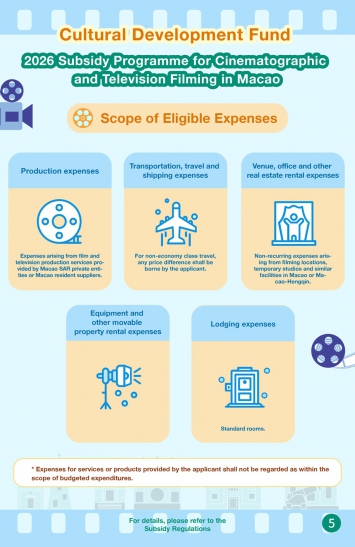
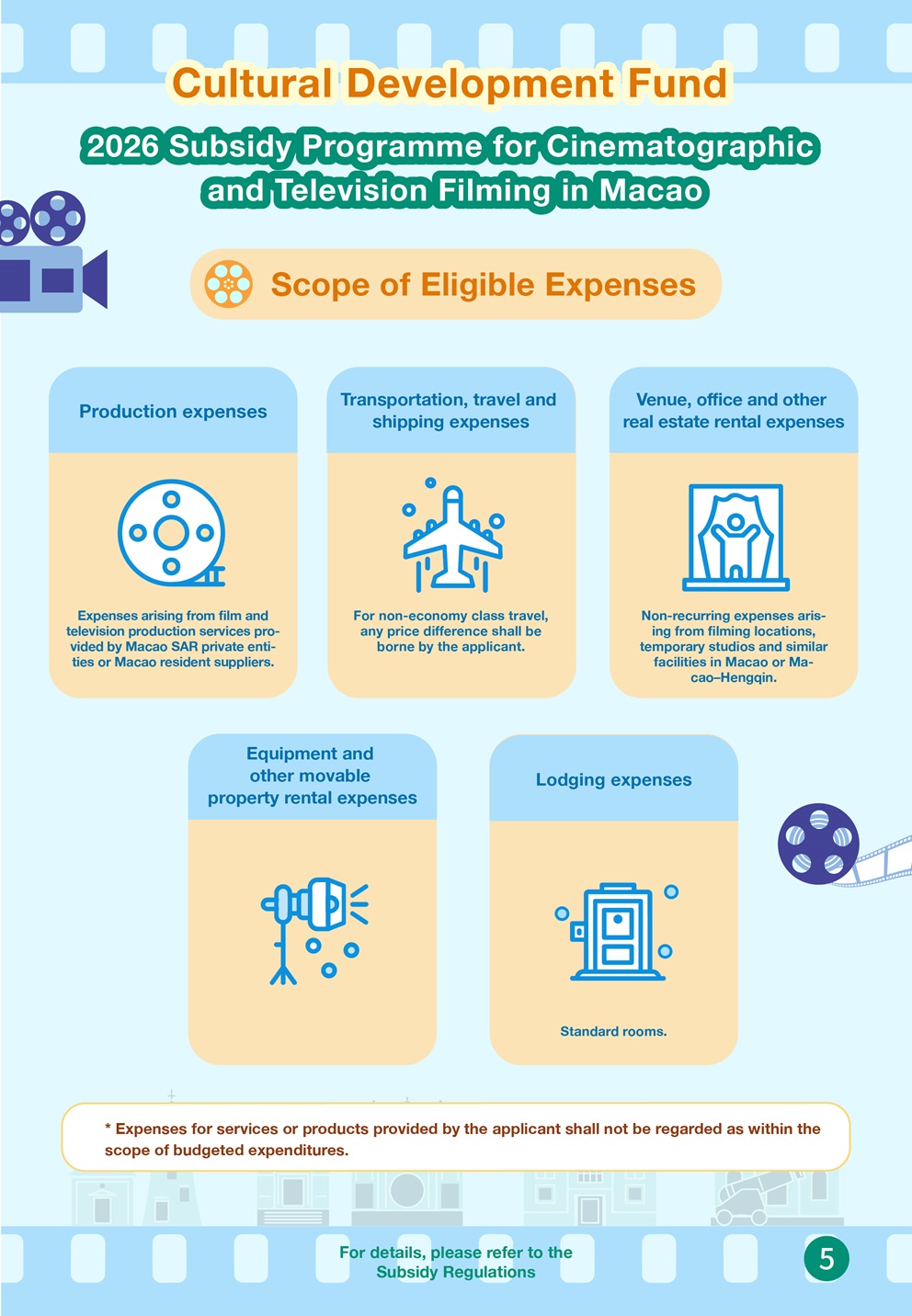
8.1Eligible expenses that can be included in the budget include project-related expenses incurred by the beneficiary during the subsidy period: 8.1.1Production expenses (Macao SAR private entities or Macao resident suppliers): limited to fees arising from services or products provided by Macao SAR private entities or Macao residents for film and television production (filming, performance, and behind-the-scenes work carried out in Macao or Hengqin Guangdong–Macao In-Depth Cooperation Zone, for micro-short dramas), including personnel costs for the producer, directing team, production team, cast, camera crew, lighting crew, art and costume team, makeup and hairstyling team, sound recording team, etc.; material costs such as props, sets, and costumes; as well as post-production costs (sound effects, editing, color grading, CG effects, scoring). 8.1.2Transportation, travel, and shipping expenses: only subsidizes economy-class travel for members of the filming crew traveling to and from Macao or Hengqin (for micro-short dramas) (as a general rule, the point of departure or arrival must be Macao or Hengqin, for micro-short dramas). For non-economy class, if a reference price for the same itinerary in economy class can be provided (e.g., the economy-class price for the same flight at the same time shown on the official website), subsidy funds may be used at the economy-class price, but any difference must be borne by the applicant. Local transportation costs in Macao or Hengqin Guangdong–Macao In-Depth Cooperation Zone (for micro-short dramas) and equipment shipping expenses are also eligible. 8.1.3Venue, office, and other real estate rental expenses: Limited to non-recurring expenses arising from filming the project in Macao or Aoqin (e.g., if it is a micro-short drama), such as local location rentals, temporary studios, etc. If subleasing is involved, documents that meet legal requirements must be submitted. 8.1.4Equipment and other movable property rental expenses: Limited to costs arising from renting equipment and gear (camera equipment, lighting equipment, sound recording equipment, generator truck/machine, dolly/track) for projects filming in Macao or Aoqin (for micro-short dramas). 8.1.5Lodging expenses (standard rooms): Limited to accommodation costs (standard rooms) at venues licensed for hotel operations in Macao or Hengqin (for micro-short dramas) for personnel directly involved in filming, performance, and behind-the-scenes production. 8.2Items not eligible for subsidy but included in the budget expenses are as follows: 8.2.1Production expenses (suppliers other than Item 8.1.1): Limited to costs arising from services or products for film and television production (filming, performance, and behind-the-scenes production in Macao or Aoqin (for micro-short dramas)) provided by suppliers other than Item 8.1.1, including work visa fees and additional bonus pay during filming in Macao. 8.2.2Lodging expenses (non-standard rooms): Accommodation costs (non-standard rooms) at venues licensed for hotel operations in Macao or Hengqin (for micro-short dramas) for personnel directly involved in filming, performance, and behind-the-scenes production. 8.2.3Insurance expenses: Including insurance costs arising from filming conducted in Macao or Aoqin (for micro-short dramas). 8.2.4Other expenses: Limited to meal expenses, equipment purchase or maintenance costs, and costs for executing agreed procedures arising from filming conducted in Macao or Aoqin (for micro-short dramas). 8.3The expenses referred to in Items 8.1 and 8.2 may be regarded as within the scope of budgeted expenditures for location shooting work conducted in Macao or Aoqin (for micro-short dramas). Other expenses, as well as costs for services or products provided by the applicant, are not regarded as within the scope of budgeted expenditures.
-
Subsidy adjustment
9.1If, upon conclusion, the actual expenditures for location shooting work conducted in Macao or Aoqin (for micro-short dramas) of the subsidized project are lower than the original budgeted expenditures, the subsidy amount will be adjusted proportionally [(budgeted expenditures - actual expenditures) / budgeted expenditures]. 9.2If, at the time of final review, the number of Macao residents participating in the subsidized project is less than 80% (rounded to the nearest whole number) of the originally planned number of job opportunities for Macao residents, the subsidy amount will be adjusted proportionally by [(Planned headcount - Actual headcount) / Planned headcount]. 9.3Without prejudice to the application of points 3.1 or 3.2, if at the time of final review the actual duration of on-location shooting in Macao or Hengqin Guangdong–Macao In-Depth Cooperation Zone (for micro-short dramas) is less than 80% (rounded to the nearest whole number) of the originally planned on-location shooting duration, the subsidy amount will be adjusted proportionally by [(Planned duration - Actual duration) / Planned duration]. 9.4If multiple downward adjustment scenarios occur, the reduction ratios will not be cumulative, and the maximum reduction ratio among them will be used as the final adjustment ratio. 9.5If the circumstances described in points 9.2 to 9.3 arise due to force majeure or for reasons confirmed by the Administrative Committee of the Fund as not attributable to the beneficiary, the Fund may refrain from adjusting the subsidy amount.
-
Funding period
10.1The subsidy period is 36 months, commencing at the earliest on the day following the applicant’s online confirmation of submission, and at the latest on the first day of the month following the signing of the agreement; the specific start date shall be agreed upon by the Fund and the beneficiary. 10.2The beneficiary shall complete the implementation of the subsidized project within the subsidy period. 10.3Upon a prior application submitted by the beneficiary within the subsidy period with appropriate justification, the Administrative Committee of the Fund may approve one or more extensions of the subsidy period; however, the total extended period may not exceed half of the original subsidy period. 10.4Applications submitted after the deadline mentioned above will not be accepted by the Fund, except in cases of force majeure or other reasons not attributable to the beneficiary.
-
Guarantee
11.1If the applicant is a corporate business owner, its principal shareholders must provide a credit guarantee to secure the beneficiary’s obligations to refund or repay the subsidy amount in the event such refund or repayment is required (e.g., if the grant award is cancelled or the project’s actual expenditure is lower than the budgeted expenditure), except where the principal shareholders are public legal persons. 11.2The subsidized party and guarantor referred to above must issue a promissory note equivalent to the subsidized amount and a statement of liability as a guarantee, and the relevant signatures must be authenticated on the spot. 11.3If the subsidized party agrees to have the full subsidy amount disbursed after the summary report is accepted by the Fund, they may be exempted from providing the guarantee referred to above.
-
Application
12.1The applicant must log in to the Cultural Development Fund’s online application system using Macao One Account/Business & Associations Platform entity user account, complete the Application Form and upload the following documents, specifically as follows: 12.1.1The applicant’s business registration certificate, if available; 12.1.2Business tax declaration (Form M/1) or a statement of commencement of business issued by the Financial Services Bureau; 12.1.3A certificate issued by the Financial Services Bureau stating that the applicant does not owe any debts to the Macao Special Administrative Region arising from assessed taxes, duties, or any other amounts; 12.1.4The applicant’s most recent business tax assessment receipt – Form M/8; 12.1.5Proof of contributions to the Social Security Fund; if not subject to contribution obligations, provide a declaration statement; 12.1.6The company’s profit and loss statements for the past two years (may be completed using the Fund’s template); 12.1.7Cooperation agreement signed between the applicant and the filming team from outside Macau, or authorization documents from the external filming team, or other equivalent documents (the agreement or authorization must indicate that the applicant is responsible for coordinating the work arrangements and budget execution for filming in Macau or Hengqin Guangdong–Macao In-Depth Cooperation Zone (if a micro-short drama), show the producer or copyright-holding entity of the work, and bear the signatures and seals of the authorizing party or both parties to the agreement for confirmation); 12.1.8Supporting documents, if any, proving that the application project meets the additional scoring conditions under points 14.5 or 14.6; 12.1.9An introduction to the content of the film/television work, such as a story synopsis; 12.1.10A detailed project proposal (it should explain the filming plan in Macau or Hengqin Guangdong–Macao In-Depth Cooperation Zone (if a micro-short drama), such as filming locations and scenes, schedule, distribution channels for the film, and a detailed list of the applicant’s responsibilities); 12.1.11The project’s financial budget and a table of positions and remuneration for the Macau team members (it is recommended to fill in according to the Fund’s format); 12.1.12The applicant’s co-production experience and the external filming team’s film/TV production experience, including records of film/TV works previously participated in, screening and distribution performance, team introduction, awards received, etc.; 12.1.13Other documents that may assist the application, such as letters of cooperation consent, estimated expense quotations, etc., as well as disclosure documents for related-party transactions, if any, as referred to in point 19.5. 12.2All application documents must be submitted online. The applicant must ensure that the information filled in and the uploaded documents are accurate. Once the application is confirmed and submitted online, the project content cannot be modified. 12.3Language for drafting the application: must be written in Chinese, Portuguese, or English. 12.4Regulations and notes to be observed for the application: 12.4.1Applicants may, in the online system, consent to the Fund assisting in reviewing the certificate of commercial registration referred to in point 12.1.1 and the certificate of no outstanding debts referred to in point 12.1.3, thereby being exempted from submitting the relevant documents. 12.4.2The Fund may require applicants to present originals of documents, provide explanations, and submit other documents, reports, or information that are indispensable to forming the application dossier. 12.4.3Unless otherwise notified by the Fund, applicants are not permitted to make changes to documents and information already submitted. 12.4.4Applicants must not make false statements, provide false information, or use other unlawful means to obtain subsidy funds. 12.4.5If the applicant intends to withdraw the application, they should immediately notify the Fund in writing, and the application will be deemed withdrawn at once. 12.4.6None of the documents received by the Fund for this program will be returned.
-
Preliminary analysis
13.1The Fund will conduct a preliminary analysis of the application dossier. If any of the following conditions apply, the Fund will reject the application and it will not proceed to the evaluation stage: 13.1.1The proposed project does not align with the Fund’s objectives. 13.1.2The proposed project does not meet the funding purpose stated in point 1. 13.1.3The proposed project does not fall within the funding scope described in point 3. 13.1.4The application project does not meet the funding requirements specified in Point 4. 13.1.5The applicant does not meet the eligibility and target beneficiary criteria specified in Point 5. 13.1.6The application documents do not comply with the application rules specified in Point 12. 13.1.7The applicant is currently overdue in repaying/has not returned/has not refunded amounts for other projects funded by the Fund. 13.1.8The applicant is on the Fund’s list of entities refused funding. 13.1.9The application project falls within the scope of funding programs already announced by other public departments or public entities in Macao. 13.1.10The applicant has submitted duplicate applications for the same project (If identical projects are submitted, the most recently submitted application will prevail, and the others will be rejected). 13.1.11The audiovisual work of the application project is a pornographic film as defined by Law No. 10/78/M of July 8 (which establishes measures regarding the sale, display, and exhibition of pornographic and obscene materials in this region), or is classified as pornographic in another jurisdiction. 13.1.12The application project contains improper elements such as promoting indecency, violence, pornography, obscenity, gambling, coarse or filthy language, insinuations, or infringements on the rights of others. 13.1.13The content of the application project involves endangering national security or violating public order or good morals. 13.1.14The content of the application project involves harming the image and reputation of the Macao Special Administrative Region Government and the Cultural Development Fund; 13.1.15The content of the proposed project would negatively affect the image of the Macao SAR; 13.1.16The applicant fails to submit the required documents within the specified period, or the supplementary documents still do not meet the requirements; however, this does not affect the applicability of point 13.2. 13.2If the documents referred to in points 12.1.1 to 12.1.8 are missing or the relevant documents do not meet the requirements, the Fund may require the applicant to submit the relevant documents within 5 days. 13.3If none of the circumstances for rejecting the application arise, the Administrative Committee of the Fund will forward the application file to the Activities and Projects Assessment Committee for evaluation.
-
Evaluation and Award Decision
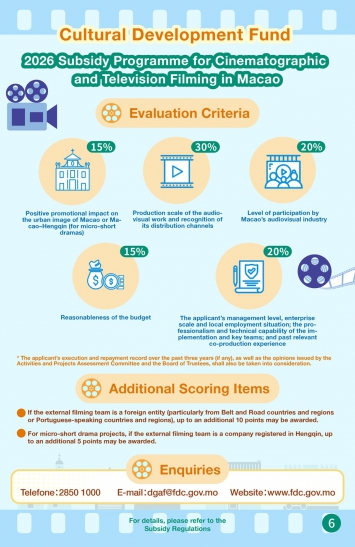
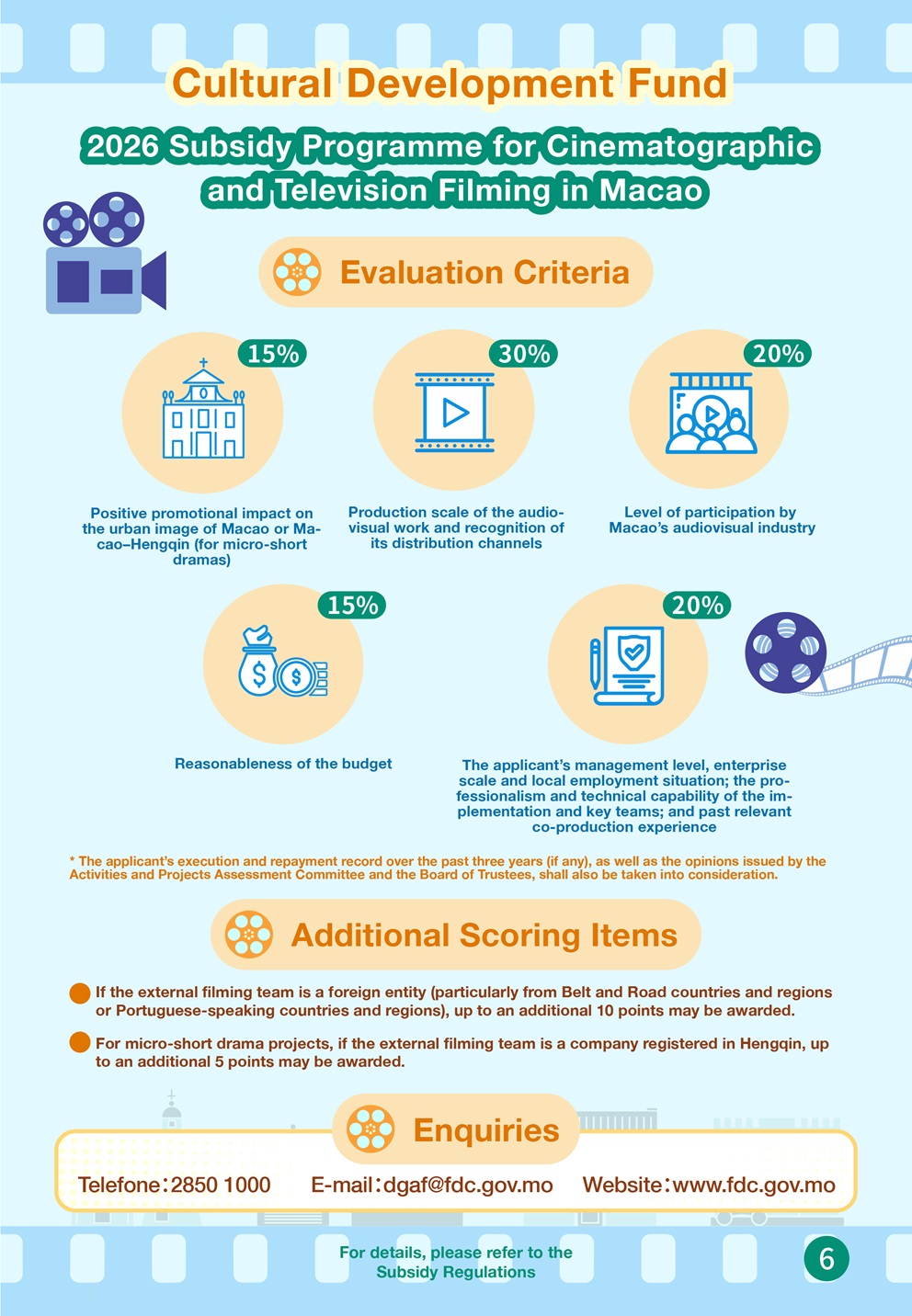
14.1The members of the Activities and Projects Assessment Committee are appointed by the Chair of the Administrative Committee, who, based on the nature of the project to be deliberated, invites three to seven experts from the expert roster in the relevant fields, namely from the film and television sector, academia, and the business sector. 14.2The Activities and Projects Assessment Committee may convene a meeting only when at least a majority of its members are present, and minutes must be prepared for each meeting, recording the evaluation results and key matters of the meeting. 14.3The applicant’s representative must attend the evaluation meeting to present the content of the proposed project and answer evaluation questions. If the applicant is unable to attend for justified reasons, a written evaluation will be conducted based on the documents already submitted; otherwise, it will be deemed a withdrawal of the application. 14.4The Activities and Projects Assessment Committee will score according to the following evaluation criteria (100 points as the full score): 14.4.1The project’s positive promotional impact on the urban image of Macao or Hengqin Guangdong–Macao In-Depth Cooperation Zone (for micro-short dramas) (15%); 14.4.2The production scale of the audiovisual work and the recognition of its distribution channels (30%); 14.4.3The level of participation by Macao’s audiovisual industry (20%); 14.4.4The reasonableness of the budget (15%); 14.4.5The applicant’s management level, enterprise scale and local employment situation; the professionalism and technical capability of the implementation and key teams; and past relevant co-production experience (20%). 14.5If the external filming team is a foreign entity (particularly from Belt and Road countries and regions or Portuguese-speaking countries and regions), the application may receive additional points, up to a maximum of 10 points. 14.6For micro-short drama projects, if the external filming team is a company registered in Hengqin, it may receive additional points, up to a maximum of 5 points. 14.7A review score of no less than 60 points is deemed to have passed the assessment. 14.8After fully considering the following opinions and records, the granting entity shall make a decision on the application and may attach conditions: 14.8.1Opinions issued by the Activities and Projects Assessment Committee; 14.8.2Opinions of the Board of Trustees (where applicable); 14.8.3Applicant’s execution and repayment record for funded activities and projects over the past 3 years (especially records of written warnings, funding reductions, and cancellations of grants). 14.9The Administrative Committee of the Fund may, at its discretion or in response to opinions issued by the Activities and Projects Assessment Committee or the Board of Trustees, require the applicant to adjust the content of the application project, provide supplements, and complete the application materials in the format specified by the Fund within a designated period. 14.10The amount of the grant awarded is related to the budget scale of the application project and the assessment score obtained. 14.11In particular, the Administrative Committee of the Fund may decide not to award a grant in the following circumstances: 14.11.1The application project fails the assessment; 14.11.2The applicant violates the provisions of point 14.9; 14.11.3The budget for this grant Programme has been exhausted; 14.11.4It is subsequently discovered that the application project falls under the circumstances referred to in point 13.1.
-
Agreement
15.1The Fund and the grant recipient must sign an agreement, and the agreement must set out the contents of the grant award decision. 15.2Consequences of not signing the agreement: If the grant recipient does not sign the agreement by the date (generally no more than 30 days from the date of notification to sign the agreement), time, and place specified by the Fund, the grant award will lapse, except in cases of force majeure or for reasons confirmed by the Administrative Committee of the Fund as not attributable to the grant recipient.
-
Changes to Project Content
16.1If changes to the project content do not deviate from the core of the project—such as adjustments to filming techniques, script content (not involving changes to the “story outline”), or non-key members—the beneficiary may flexibly make adjustments based on actual circumstances and provide an explanation when submitting the report. 16.2If changes to the project content involve any of the situations indicated below, the beneficiary must submit an application for prior approval by the Fund: 16.2.1Reducing or altering more than 50% of the originally planned filming locations and scenes in Macao or Hengqin Guangdong–Macao In-Depth Cooperation Zone (for micro-short dramas, if applicable); 16.2.2Reducing or altering the originally planned public broadcast channels; 16.2.3Changing the story outline; 16.2.4Changing the title of the audiovisual work; 16.2.5Adding, removing, or altering the beneficiary’s existing shareholders, members of the administrative management body, or the originally planned director or producer of the audiovisual work; 16.2.6Reducing or altering more than half of the project team’s key members listed on the application form; 16.2.7Other changes that affect the core of the project. 16.3The Fund does not accept applications for changing the type of project film.
-
Submit start-of-production proof, progress execution reports, final report, and agreed-upon procedures execution report
17.1From the day following the signing of the agreement, the grantee must, within 60 days, notify the Fund in writing of the practitioner accountant, accounting firm, accountant providing accounting and tax services, or accounting company providing accounting and tax services selected for the project, and submit the engagement letter. 17.2The grantee must submit the following proofs and reports on time, and fill them out in the format specified by the Fund: 17.2.1The grantee must submit start-of-production proof documents within 30 days after the project starts production (such as photos of filming activities, etc.). 17.2.2The grantee must submit the project progress execution report to the Fund by the last day of the month following every 12-month interval. 17.2.3Within 30 days after project completion (the implementation period must not exceed the funding period), the grantee must submit the final report to the Fund, and within 90 days submit the “Agreed-Upon Procedures Execution Report” (prepared after the practitioner accountant, accounting firm, accountant providing accounting and tax services, or accounting company providing accounting and tax services engaged by the grantee performs agreed-upon procedures on the income and expenditure of the funded project; the grantee is responsible for the related costs). 17.2.3.1Projects with a funding amount of MOP 1,000,000 or above: the grantee must, through the Public Assets Supervision and Administration Bureau’s “Declaration System for Final Reports of Funded Activities or Projects,” upload and submit electronically the final report and the Agreed-Upon Procedures Execution Report in accordance with the preparation requirements; 17.2.3.2Projects with a funding amount not exceeding MOP 1,000,000: the grantee must submit the final report and the Agreed-Upon Procedures Execution Report to the Fund in accordance with the preparation requirements. 17.2.4The grantee must submit the above report documents in accordance with the preparation requirements. 17.3The format of the engagement letter referred to in point 17.1 and the Agreed-Upon Procedures Execution Report referred to in point 17.2.3 must comply with the relevant provisions of the Public Assets Supervision and Administration Bureau’s Guideline No. 001/GPSAP/AF/2023 on Verification of Funded Activities or Projects. 17.4Supporting documents attached to the report: When the beneficiary submits the project progress execution report and the final summary report, they must attach supporting documents demonstrating the project’s implementation status, including but not limited to the following: Documentary documents - Complete list of the production team involved in filming in Macao;
- Work photos from the filming period (no fewer than 6 photos, with the period to which the photo belongs and the filming location indicated);
- Relevant proof of public screening information and sales channels (including screenshots of online sales platforms or screenshots of distribution/screening channels on film and video platforms);
- Proof of screening performance (including box office data; if screened on film/video platforms or played on internet websites, proof such as click-through/traffic data must be provided);
- Media coverage.
- A 3-minute behind-the-scenes video recorded during the filming period;
- Audio-visual file of the final film;
- An audio-visual file containing edited clips of all locations in Macao or Hengqin Guangdong–Macao In-Depth Cooperation Zone (if a micro-short drama) appearing in the final film.17.5Application for Deferred Report Submission: If, due to force majeure or other reasons not attributable to the beneficiary, it becomes impossible to submit the report within the period stipulated in point17.2, the beneficiary must notify the Fund within 7 working days from the date the relevant facts occur. 17.6If the situation referred to above applies, upon approval by the Administrative Committee of the Fund, the period for submitting the report shall be within 30 days counting from the day after the aforementioned reason ceases, without affecting the application of the provisions set out below. 17.7In exceptional cases with a justified explanation, the Administrative Committee of the Fund may approve a one-time extension of the period referred to in point 17.2, not exceeding 90 days. 17.8If the Fund considers the documents unclear or incomplete, the beneficiary must submit the supplementary documents within the period specified by the Fund. If the deadline passes without submission, or the supplementary documents still do not meet the requirements, the case will be closed based on the documents currently submitted, without affecting the application of the consequences of late submission, except in cases of force majeure or other reasons not attributable to the beneficiary. If closure conditions are not met, the Fund may cancel the grant award.
-
Confirmation of expenses
18.1Purpose and mandatory nature of expense confirmation: To ensure that the expenses actually incurred by the beneficiary in the funded activities and projects are expenses eligible for funding under these Regulations, expenses must be confirmed by the Fund. 18.2Method of confirmation: Through the beneficiary’s submission of the Agreed-Upon Procedures report, on a reimbursement basis, and the beneficiary must keep the original income and expenditure vouchers of the funded project intact for at least 5 years, so that the Fund can conduct inspections if needed. 18.3Requirements for vouchers: 18.3.1When the expense recipient is a company or institution: The relevant expense vouchers, such as invoices or receipts issued by the company or institution, must include the names of both buyer and seller, the name of the product or service, issue date, voucher number, amount, and the seller’s contact details, such as address, telephone number, email address, etc., or the beneficiary must indicate the above contact details of the relevant company or institution. If the expense involves leasing property, in addition to the above information, the invoice or receipt must also include the address of the property. 18.3.2When the expense recipient is a natural person: The relevant expense vouchers, such as receipts issued by the natural person (including the names of both buyer and seller, the name of the product or service, issue date, voucher number, amount, and the seller’s contact details such as address, telephone number, email address, etc., or the beneficiary must indicate the above contact details), or the Professional Tax M/7 format voucher (including the names of the customer and issuer, the name of the service, the issuer’s tax identification number, issue date, voucher number, the business listed in the annex to the Professional Tax Regulations, and the amount). 18.3.3Other provisions on vouchers: 18.3.3.1When an expense amount on a receipt involves a discount, the actual amount paid must be indicated. 18.3.3.2For transactions using the Fund’s subsidy in the amount of 100,000 Macao Patacas or above, the receipt must be a paid invoice or receipt, and the beneficiary must also submit proof of payment for the transaction (such as a copy of the cheque, transfer records, payment records from online payment tools; if the expense was paid in cash, evidentiary documents of the expense must be submitted, such as photos of the physical items or photos of the service provision process). If the relevant expense involves a payment to a Mainland China entity, a standardized official invoice in the local unified format must also be submitted. 18.3.3.3If the transaction involves a currency other than Macao Patacas, the beneficiary should specify the name of the currency involved and the exchange rate. 18.3.3.4If the receipt information is incomplete, the beneficiary must provide a written explanation, and the beneficiary, as the signatory, must sign the relevant documents and indicate the date of signature. 18.3.3.5If information on the receipt needs to be amended, the product or service provider should make the amendment in accordance with the facts and affix a stamp at the place of amendment to authenticate it. 18.3.3.6If a transaction involves a related-party transaction as referred to in point 19, the beneficiary should make a note on the receipt and provide the contact information of the relevant counterparty.
-
Related-party transactions
19.1For the purposes of applying the provisions of these Regulations, a “related party” refers to a party that has a related relationship with the applicant or beneficiary, as defined below: If the applicant/beneficiary is a natural person business owner, related parties include: If the applicant/beneficiary is a legal person business owner, related parties include: 1. The spouse, children, parents, siblings of the applicant for funding/beneficiary, the spouse’s parents, the spouse’s siblings, as well as any person in a de facto marital relationship with them;
2. Commercial enterprises (natural persons) owned by the applicant for funding / the funded party;
3. Companies in which the applicant for funding / the funded party serves as a controlling shareholder or a member of the administrative management body; 1
4. Commercial enterprises (natural persons) owned by the person referred to in point 1;
5. Companies in which the person referred to in point 1 serves as a controlling shareholder or a member of the administrative management body.1. The controlling shareholders of the company applying for or receiving funding (including natural-person and legal-entity shareholders, especially its parent company) and members of the administrative management body, as well as the spouses, children, parents, siblings, parents-in-law, siblings-in-law, and persons in a de facto marital relationship with these two categories of persons;
2. Companies in which the company applying for or receiving funding serves as a controlling shareholder, especially its subsidiaries, are also related parties;
3. Commercial enterprises (natural persons) owned by the person referred to in point 1;
4. If the person referred to in point 1 serves as a controlling shareholder or a member of the administrative management body in another company, then that company is a related party of the company applying for or receiving funding.1 “Controlling shareholder” means a natural or legal person who, either individually, holds a majority of the share capital of a company; or who, together with other companies that are also controlling shareholders, or together with other shareholders linked by way of quasi-company agreements, jointly holds a majority of the share capital of the company; or who holds more than half of the voting rights; or who has the right to cause the election of a majority of the members of the administrative management body. 19.2When conducting related-party transactions, the applicant or the funded party shall ensure that such transactions are fair and reasonable, particularly that the transaction prices do not deviate from reasonable market prices. 19.3If, at the funding application stage, the applicant anticipates entering into or has entered into, or at the project implementation stage, the funded party has entered into, related-party transactions falling under the following circumstances, the applicant or the funded party must make declarations in the application documents or the final report, respectively, and this does not affect the applicability of the provisions set out below: 19.3.1Regardless of whether the Fund’s subsidy is used, the applicant or beneficiary must declare when the cumulative amount of transactions with the same related party is expected to reach or actually reaches 100,000 Macau patacas or more. 19.4For the situations requiring declaration referred to in point 19.3.1 and where the use of the Fund’s subsidy amounts to 100,000 Macau patacas or more, the applicant or beneficiary must also provide documentary proof that, in advance, they additionally sought quotations from at least 2 suppliers that are non-related parties (i.e., not related parties as defined in point 19.1), and the following rules apply: 19.4.1The quotation documents must include clauses in which suppliers declare that they are “mutually independent and have not engaged in prior coordinated pricing” with other suppliers participating in the quotation process; 19.4.2The Fund will use the lowest quoted price as the upper limit for expense recognition; 19.4.3If the relevant proof of having sought quotations cannot be submitted, the related expenses cannot be paid using the Fund’s subsidy, without prejudice to the application of the provisions in the following point; 19.4.4If the related party holds exclusive rights to the goods or services provided, seeking quotations is not required, but proof of the exclusive rights must be submitted (for situations where the holder of the exclusive rights is widely known, proof is not required). 19.5The contents of the declared related-party transactions should include: 19.5.1The name or corporate name of the related party, and contact information; 19.5.2The relationship between the related party and the applicant or beneficiary; 19.5.3The contents of the related-party transaction, including: the expected or actual transaction date, subject matter, and amount; 19.5.4Reasons for engaging in related-party transactions, for example: the price of the related transaction is better than the reasonable market price; due to technical or professional capabilities, the related party performs better than comparable entities; the related party holds exclusive rights to the goods or services it provides; 19.5.5Supporting documents or materials that demonstrate the reasonableness of the related-party transaction price. 19.6For the purposes of applying point 19.5.5, the beneficiary may use the inquiry documents referred to in point 19.4 as supporting documents or materials to demonstrate the reasonableness of the transaction price. 19.7If the information on related-party transactions that was declared at the funding application stage as expected to be conducted or already conducted changes, the beneficiary shall provide the updated information and documents in the final report. 19.8If the applicant or beneficiary violates the provisions of these Regulations regarding related-party transactions, the Administrative Committee of the Fund may disallow the expenses involved in the related-party transactions. In serious cases, depending on the stage of the file, the Administrative Committee of the Fund may reject the funding application, refrain from granting the funding, or cancel the grant.
-
Disbursement method
20.1The subsidy funds will be disbursed according to the proportions in the table below, without prejudice to the application of the following clause and point 11.3: Installment First installment
(After signing the agreement)Second installment
(After the beneficiary submits the proof of commencement)Final installment
(After the summary report is accepted)Subsidy distribution ratio 40% 40% 20% 20.2If the beneficiary breaches obligations stipulated under other plans already subsidized by the Fund, the Fund may defer the disbursement of the subsidy until the relevant obligations have been fulfilled.
-
Obligations of the beneficiary
21.1The beneficiary must fulfill the following obligations: 21.1.1Provide information and make declarations truthfully; 21.1.2Use the grant funds for the purposes specified in the award decision; 21.1.3Carefully and reasonably plan and organize the subsidized activities or projects; 21.1.4When conducting related-party transactions, ensure that such transactions are fair and reasonable, especially that the transaction price does not deviate from a reasonable market price; 21.1.5Submit the reports and supporting documents referred to in point 17 on time; 21.1.6Accept and cooperate with the Fund’s monitoring of the use of the subsidy funds, including the inspection of relevant income and expenditure and financial status; 21.1.7Return the subsidy funds in accordance with the provisions of point 23.3.1; 21.1.8Return any subsidy funds not used for the specified purpose; 21.1.9Keep the original income and expenditure vouchers of the subsidized project intact for at least 5 years; 21.1.10Open a dedicated account (Macau Patacas) in a bank in Macau in the name of the beneficiary for the subsidized project to hold the subsidy funds, except in the circumstances under point 11.3. The beneficiary may deposit the project’s income and its own funds into the dedicated account and must ensure that unused subsidy funds are kept in the dedicated account. If, due to operational needs, unused subsidy funds must be kept in other accounts, the beneficiary must provide relevant supporting documents; 21.1.11In accordance with the Fund’s instructions, participate in or refrain from participating in activities designated by the Fund, and ensure that the subsidized project does not participate in activities designated by the Fund that are prohibited or discouraged by national official bodies; 21.1.12Actively cooperate with the Fund’s project monitoring, training, or promotional activities, and agree that the Fund has the right to record the entire project process in text, photography, filming, and other forms; 21.1.13In audiovisual works and any project-related promotional activities, press releases, and promotional materials, indicate receipt of “subsidy from the Cultural Development Fund of the Macao Special Administrative Region Government” or “Funding entity: Cultural Development Fund of the Macao Special Administrative Region Government,” or an equivalent expression; and, if requested by the Fund, include specific wording, graphics, and logos; 21.1.14Upon agreeing to sign the agreement, the basic information and outcomes of the subsidized project—especially photos, text, image files, and data—will be published on the Fund’s website and in public-facing documents for promotional purposes; 21.1.15To verify the circumstances referred to in 4.3, agree that the Fund may provide or obtain information on the subsidized project from other public departments or entities; 21.1.16Ensure that the content of the subsidized project and the project execution procedures do not violate legal provisions; ensure that the project outcomes do not negatively impact the image of the Macao SAR; and ensure the legality of the process of producing the project outcomes, including the tools used, methods adopted, and information obtained. Do not sensationalize indecency, violence, pornography, obscenity, gambling, foul language, insinuation, or any situation that infringes the lawful rights and interests of third parties; 21.1.17Do not engage in acts that endanger national security or violate public order or good morals; 21.1.18Do not engage in acts that damage the image and reputation of the Macao Special Administrative Region Government and the Cultural Development Fund; 21.1.19Do not engage in acts that have a negative impact on the image of the Macao SAR; 21.1.20Ensure that the director, producer, and leading actors of the subsidized audiovisual work do not engage in the acts referred to in 21.1.17 to 21.1.19; 21.1.21Comply with the terms set out in the agreement signed with the Fund; 21.1.22Comply with the guidelines issued by the Fund and the Public Assets Supervision and Administration Burea for monitoring; 21.1.23Comply with Administrative Regulation No. 18/2022 “Public Financial Subsidy Regime of the Macao Special Administrative Region,” the “Regulations on Granting Subsidies by the Cultural Development Fund” approved by Dispatch No. 5/2023 of the Secretary for Social Affairs and Culture, other applicable laws and regulations, and the provisions of these Articles.
-
Termination of execution or failure to complete activities and projects
22.1During the funding period, if any of the following situations occur, the Fund may approve the beneficiary’s application to terminate the execution of the project, without prejudice to the applicability of clause 23.1: 22.1.1Due to force majeure or reasons confirmed by the Fund as not attributable to the beneficiary, it is anticipated that the project cannot be completed within the funding period; 22.1.2The beneficiary undertakes to return all funding amounts already received. 22.2If the situation referred to in clause 22.1.1 occurs and approval is granted by the Fund, the beneficiary must submit a final report within the period specified by the Fund to facilitate the project closure procedures. 22.3If the situation referred to in clause 22.1.2 occurs and approval is granted by the Fund, the beneficiary must return all funding amounts already received within 30 days from the date of receiving the notification of approval of the application; otherwise, the Fund will proceed with compulsory collection and will refuse any funding applications submitted by the beneficiary within two years from the expiry of the return period. 22.4If the application referred to in clause 22.1.1 is not approved, the beneficiary must continue to execute the project; otherwise, the Fund may cancel the funding award. 22.5If, upon expiry of the funding period, the beneficiary fails to complete the project due to force majeure or reasons confirmed by the Fund as not attributable to the beneficiary, the Fund must carry out the project closure procedures; if the reasons are not confirmed by the Fund, the Fund may cancel the funding award. 22.6If the project fails to be completed for reasons other than those mentioned above, the Fund may cancel the funding award.
-
Cancellation of funding award
23.1Situations in which the Fund must revoke the grant: 23.1.1The beneficiary makes false statements, provides false information, or obtains grant funds through other illegal means; 23.1.2The beneficiary uses the grant funds for purposes other than those specified in the award decision; 23.1.3The beneficiary breaches the duty to prudently and reasonably plan and organize the funded activities or projects, thereby causing serious risks or harm to participants or the public interest, especially public safety or social order; 23.1.4The activities carried out by the beneficiary involve acts that endanger national security, or violate public order or good morals; 23.1.5The beneficiary engages in conduct that damages the image and reputation of the Macao Special Administrative Region Government and the Cultural Development Fund; 23.1.6The audiovisual works of the funded project fall under pornographic films as defined by Law no. 10/78/M of July 8 (establishing measures on the sale, display, and exhibition of pornographic and obscene items in the local region), or are classified as pornography abroad; 23.1.7The funded project contains improper elements that glorify or depict indecency, violence, pornography, obscenity, gambling, foul language, insinuations, or infringements of others’ rights; 23.1.8No longer complies with Point 1 (Purpose of Funding), Point 3 (Scope of Funding), Point 4 (Funding Requirements), Point 5 (Eligibility and Target Beneficiaries), and fails to rectify the noncompliance within the period set by the Fund; 23.1.9Other situations stipulated in these Regulations that require revocation of the grant. 23.2Situations in which the Fund may cancel the grant: 23.2.1The review results of the project’s progress deviate from the core; 23.2.2The change application referred to in point 16.2 is not approved, and the beneficiary continues to implement the content after the change; 23.2.3The situation referred to in point 17.8; 23.2.4The content of the subsidized project causes a negative impact on the image of the Macao SAR; 23.2.5The situations referred to in points 22.4 to 22.6; 23.2.6Violation of other provisions of these regulations. 23.3Consequences of cancellation of the subsidy grant: 23.3.1The beneficiary must return all subsidy funds received within 30 days from the date of receipt of the relevant notification. 23.3.2If it is the situation referred to in point 23.1, the Fund must refuse any subsidy applications submitted by the beneficiary within two years from the date the beneficiary receives the notification of the consequences of the cancellation of the subsidy grant. 23.3.3If it is the situation referred to in point 23.2, the Fund may simultaneously impose the penalty of refusing any subsidy applications submitted by the beneficiary within two years from the date the beneficiary receives the notification of the consequences of the cancellation of the subsidy grant. 23.4Consequences of failing to return the funds referred to in point 23.3.1: 23.4.1If the outstanding amount of the granted subsidy is not returned within the stipulated period and no sufficient justification is provided in writing, it will be subject to compulsory collection by the Tax Enforcement Department of the Financial Services Bureau.
-
Subsidy reduction and written warning
24.1If a beneficiary is late in submitting reports and supporting documents, CDF may make the following deductions from the subsidy: Situation Subsidy reduction Submitting the project progress execution report, final report, agreed procedures execution report, or relevant supporting documents after the deadline (except for those approved for an extension) 1. Depending on the number of occurrences, reduce the corresponding percentage of the subsidy amount for the funded project as follows:
- If it occurs 1 time: reduce by 5%
- If it occurs 2 times: reduce by 10%
- If it occurs 3 times or more: deduct 15%
2. The above funding reduction is calculated cumulatively with Item 9 (Funding Adjustment). After reductions, the grant amount = Approved grant amount *(1-A)*(1-B), where A and B are the funding reduction and adjustment ratios.
Note:
A is the funding adjustment ratio referred to in Item 9.
B is the funding reduction ratio for submitting reports or relevant supporting documents after the deadline.24.2If the beneficiary violates the provisions of these Regulations, especially the obligations of the beneficiary stipulated in Item 21, the Fund may, depending on the nature and severity of the breach, decide to reduce the funding or issue a written warning.
-
Others
25.1The Fund only provides funds for the subsidized project and does not participate in any commercial activities or business decisions of the beneficiary. Any decisions, activities, statements, etc., whether related to the project or not, made by the beneficiary do not represent the position of the Fund. 25.2The beneficiary must comply with the laws of the Macao SAR, Mainland China, or other countries/regions. If any activities or decisions by the beneficiary result in violations of the laws of the Macao SAR, Mainland China, or other countries/regions, leading to civil, criminal, or administrative liability, the beneficiary shall bear such liability independently. 25.3The beneficiary must apply to and obtain from the relevant authorities (including the Macao SAR and overseas) all types of licenses and permits necessary for the project. 25.4The Fund reserves the right to amend the provisions of these Regulations before the start of each application cycle, and the amended Regulations will apply to subsequent funding applications. 25.5By participating in this Program, the applicant is deemed to have thoroughly read and understood, and agrees to comply with all terms and content of these provisions without objection. 25.6Matters not mentioned in these Regulations shall be governed by the current laws and regulations applicable in the Macao Special Administrative Region, in particular Administrative Regulation No. 40/2021 “Organization and Operation of the Cultural Development Fund,” Administrative Regulation No. 18/2022 “Public Financial Subsidy System of the Macao SAR,” the “Regulations on the Award of Subsidies by the Cultural Development Fund” approved by Order No. 5/2023 of the Secretary for Social Affairs and Culture, and other relevant provisions on subsidies of the Cultural Development Fund. 25.7The Fund has the final right of interpretation and decision over these regulations.
-
Inquiry methods
Telephone: 2850 1000;Fax: 2850 1010;Email: dgaf@fdc.gov.mo.
Only available in Chinese and Portuguese